
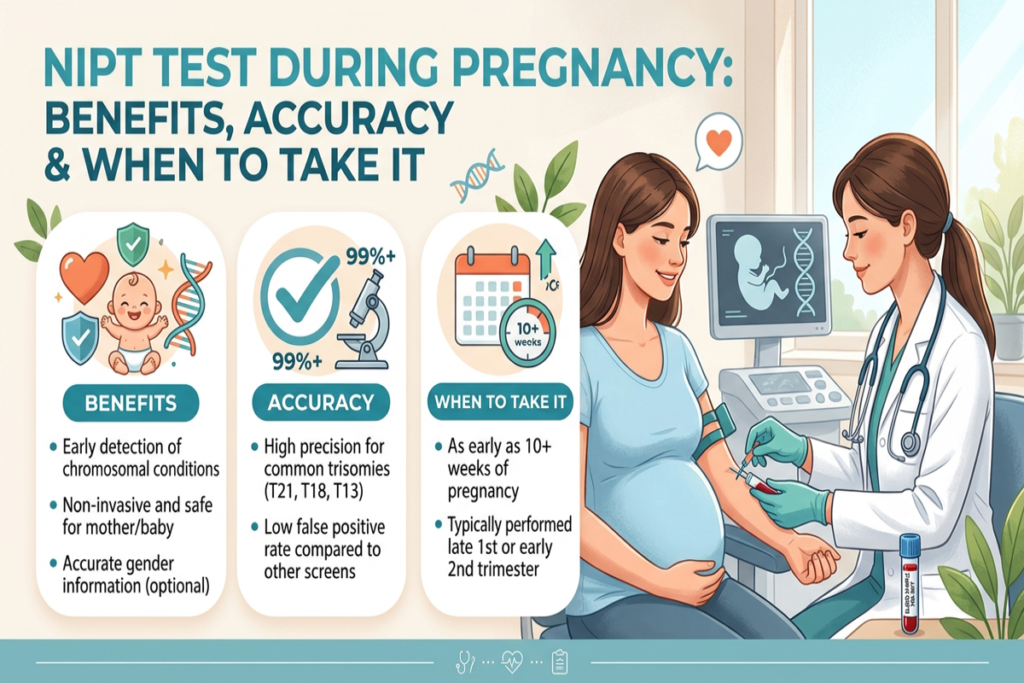
NIPT Test During Pregnancy: Benefits, Accuracy & When to Take It
Introduction
Prenatal screening plays an important role in modern pregnancy care by helping expectant parents understand the likelihood of certain genetic conditions in their baby. One of the most widely used screening options is the Non-Invasive Prenatal Test (NIPT), a blood test that analyzes small fragments of cell-free DNA circulating in the mother’s bloodstream.
NIPT can help assess the likelihood of certain chromosomal conditions without exposing the pregnancy to the risks associated with invasive diagnostic procedures. However, it is important to understand what the test can detect, when it should be performed, and what its results mean.
What Is the NIPT Test?
The Non-Invasive Prenatal Test (NIPT), also known as cell-free DNA screening, is a prenatal screening test that analyzes DNA fragments originating mainly from the placenta and circulating in the mother’s blood.
It primarily screens for an increased likelihood of certain chromosomal conditions, including:
Down syndrome (Trisomy 21): A condition caused by an extra copy of chromosome 21.
Edwards syndrome (Trisomy 18): A chromosomal condition associated with significant developmental and medical complications.
Patau syndrome (Trisomy 13): A condition caused by an extra copy of chromosome 13.
Depending on the laboratory and the test selected, additional chromosome conditions or fetal sex information may be available.
NIPT is a screening test, not a definitive diagnosis. A high-risk result generally requires further evaluation and confirmation.
When Can You Take the NIPT Test?
NIPT can generally be performed from 10 weeks of pregnancy, although the exact timing depends on the test provider and clinical circumstances.
Your obstetrician may discuss NIPT during early antenatal visits, taking into account your medical history, previous pregnancy outcomes, ultrasound findings, and personal preferences.
Testing too early or having a low proportion of placental DNA in the blood sample can sometimes result in an inconclusive result.
How Is the NIPT Test Performed?
The procedure is straightforward and involves a routine blood sample from the pregnant woman.
The process usually includes:
Consultation: Your doctor explains the screening options, benefits, limitations, and possible results.
Blood collection: A sample is taken from a vein in your arm.
Laboratory analysis: The sample is analyzed for patterns associated with selected chromosomal conditions.
Results review: Your doctor explains the findings and discusses whether additional testing is needed.
NIPT does not require entering the uterus, and the blood collection itself does not introduce the procedure-related miscarriage risk associated with invasive prenatal diagnostic tests.
How Accurate Is NIPT?
NIPT is highly sensitive for screening for Down syndrome and performs well for several other common trisomies. However, its accuracy varies according to the condition being screened for and other factors.
A high-risk result does not automatically mean that the baby has the condition. Similarly, a low-risk result greatly reduces the likelihood of the screened conditions but cannot rule out every genetic or developmental disorder.
False-positive and false-negative results are possible. Factors such as placental genetic differences, maternal genetic factors, and low fetal fraction may affect interpretation.
For this reason, screening results should always be interpreted alongside the pregnancy history and ultrasound findings.
What Happens If the NIPT Result Is High Risk?
If the result indicates an increased likelihood of a chromosomal condition, your doctor may recommend genetic counseling and further assessment.
Depending on the specific result and the stage of pregnancy, diagnostic testing may include:
Chorionic villus sampling (CVS): Usually performed earlier in pregnancy.
Amniocentesis: Generally performed from around 15 weeks of pregnancy.
These procedures can provide diagnostic information about selected chromosomal conditions. The most appropriate option depends on the individual pregnancy and should be discussed with a qualified specialist.
Decisions should not be made based on an NIPT result alone.
NIPT Compared With Other Prenatal Screening Tests
NIPT differs from other prenatal assessments in its purpose.
NIPT: Screens for selected chromosomal conditions using a maternal blood sample.
First-trimester screening: Combines ultrasound findings and maternal blood markers to estimate the likelihood of certain chromosomal conditions.
Fetal anomaly scan: Uses ultrasound to assess the baby’s anatomy and identify possible structural abnormalities.
Diagnostic testing: Tests such as CVS and amniocentesis can help confirm specific chromosomal or genetic conditions.
NIPT does not replace routine pregnancy ultrasound scans, detailed fetal anatomy assessment, or regular antenatal care.
Is NIPT Safe for the Baby?
NIPT itself is considered a safe, non-invasive screening option because it requires only a maternal blood sample.
The test does not directly access the uterus or the fetus. However, the emotional impact of uncertain or high-risk results is an important consideration, making pre-test counseling and appropriate follow-up valuable parts of prenatal care.
Who Should Consider NIPT?
NIPT may be an option for many pregnant women, including those who want more accurate screening for common chromosomal conditions.
Your doctor can help determine whether it is suitable based on your gestational age, pregnancy history, ultrasound results, and preferences. Access and recommendations may vary according to local clinical guidance.
Frequently Asked Questions
Is NIPT painful?
The test involves a routine blood draw. You may experience brief discomfort similar to that of any standard blood test.
Does NIPT detect all genetic disorders?
No. NIPT screens for selected chromosomal conditions and does not detect every genetic disorder, birth defect, or developmental condition.
Can NIPT replace an ultrasound scan?
No. Ultrasound scans provide important information about fetal growth, anatomy, and pregnancy development that NIPT cannot provide.
What does a low-risk NIPT result mean?
A low-risk result indicates a reduced likelihood of the conditions included in the screening panel. It does not guarantee that the baby has no genetic or structural condition.
What should I do if my NIPT result is inconclusive?
Contact your obstetrician to review the result and discuss the next steps. Depending on your circumstances, repeating the test, performing an ultrasound assessment, or considering another screening or diagnostic option may be appropriate.
Conclusion
The NIPT test is a valuable option in modern prenatal care, offering non-invasive screening for selected chromosomal conditions from early pregnancy. Understanding its benefits and limitations helps expectant parents make informed decisions with their healthcare team.
For personalized guidance about NIPT, prenatal screening, and pregnancy follow-up, consult a qualified obstetrician or fetal medicine specialist.
Book a consultation with Dr. Shady Saleem to discuss your prenatal screening options and develop a pregnancy care plan tailored to your needs.