
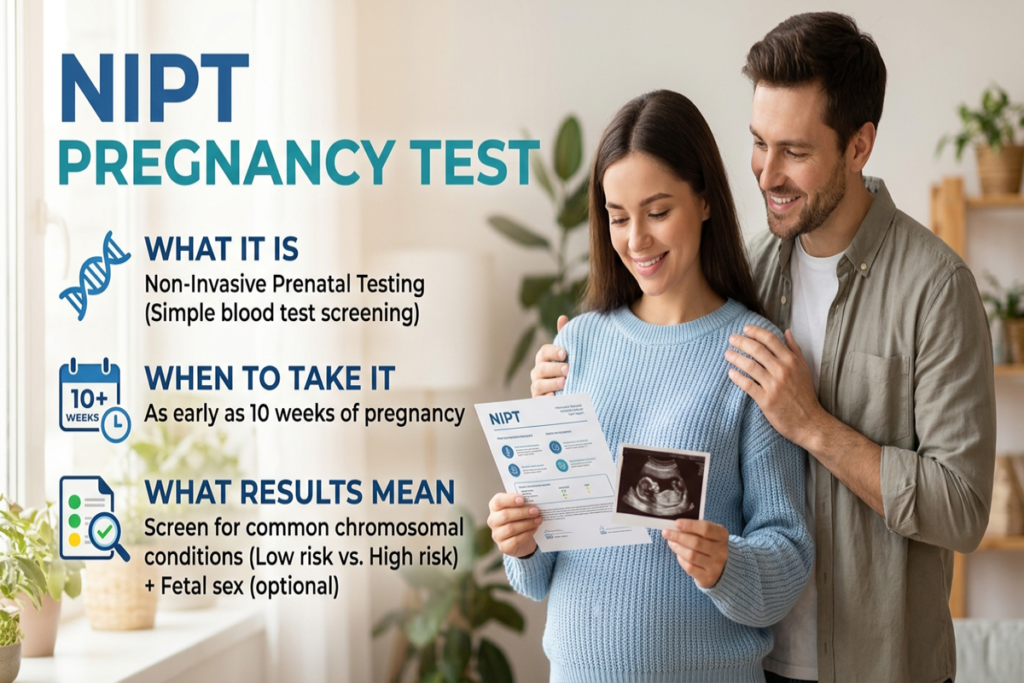
NIPT Pregnancy Test: What It Is, When to Take It & What Results Mean
?What Is the NIPT Pregnancy Test
The Non-Invasive Prenatal Test (NIPT), also known as cell-free DNA screening, is a blood test used during pregnancy to assess the chance of certain chromosomal conditions in the developing baby
The test analyzes small fragments of DNA circulating in the pregnant woman’s blood. Some of this cell-free DNA originates from the placenta and can provide information about the likelihood of specific chromosomal conditions.
NIPT is a screening test, not a diagnostic test. It can help guide decisions about further testing, but it cannot confirm or exclude every genetic or developmental condition.
When Can You Take the NIPT Test?
NIPT is commonly available from around 10 weeks of pregnancy. The appropriate timing may depend on the test provider, pregnancy circumstances, and local clinical guidance.
Your obstetrician or fetal medicine specialist can advise whether NIPT is suitable for you and explain how it fits into your overall antenatal care plan.
NIPT may be offered as part of prenatal screening for pregnant women across different age groups. The decision should consider individual circumstances, preferences, and available screening options.
What Does NIPT Screen For?
Depending on the laboratory and the specific test selected, NIPT commonly screens for certain chromosomal conditions, including:
Trisomy 21 (Down syndrome): A condition involving an extra copy of chromosome 21.
Trisomy 18 (Edwards syndrome): A condition involving an extra copy of chromosome 18.
Trisomy 13 (Patau syndrome): A condition involving an extra copy of chromosome 13.
Certain sex chromosome conditions: These may be included in some test panels.
Not every NIPT test screens for the same conditions. Expanded panels may be available, but their suitability and limitations should be discussed with a qualified healthcare professional.
NIPT does not screen for every genetic disorder, birth defect, or structural abnormality. Ultrasound examinations remain an important part of pregnancy care.
How Is the NIPT Test Performed?
One of the advantages of NIPT is that it requires only a blood sample from the pregnant woman.
The process generally includes:
Consultation: Your healthcare professional reviews your pregnancy history and explains the benefits and limitations of screening.
Blood collection: A blood sample is taken from your arm.
Laboratory analysis: The sample is analyzed for cell-free DNA patterns associated with the conditions included in the selected test.
Results and follow-up: Your healthcare professional explains the findings and whether any additional assessment is recommended.
Because the test uses a maternal blood sample, it does not carry the procedure-related pregnancy risks associated with invasive diagnostic tests such as amniocentesis or chorionic villus sampling.
Understanding NIPT Results
NIPT results are generally reported as low risk, high risk, or inconclusive/no result, although the exact wording varies between laboratories.
Low-Risk Result
A low-risk result means the test found a lower likelihood of the screened chromosomal conditions. It does not guarantee that the baby has no genetic condition or birth defect.
Routine antenatal appointments and recommended ultrasound examinations remain important.
High-Risk Result
A high-risk result means the screening test has identified an increased likelihood of a particular chromosomal condition. It does not, by itself, establish a diagnosis.
Your healthcare professional may recommend genetic counseling and discuss diagnostic testing, such as chorionic villus sampling (CVS) or amniocentesis, to clarify the result.
Decisions about further testing should be made after understanding the benefits, limitations, and potential risks of each option.
Inconclusive or No-Result Finding
Sometimes, the laboratory cannot provide a clear result. This may occur for several reasons, including an insufficient amount of placental cell-free DNA in the sample.
Your healthcare professional will review the circumstances and explain whether repeating the test, arranging additional screening, or considering diagnostic testing is appropriate.
An inconclusive result should not simply be interpreted as a low-risk result.
How Accurate Is NIPT?
NIPT is highly effective at screening for some common chromosomal conditions, particularly trisomy 21. However, its performance differs depending on the condition being screened for and the clinical circumstances.
The chance that a high-risk result reflects a true condition also depends on factors such as the condition’s prevalence in the pregnancy population and the individual pregnancy context.
For this reason, a screening result should always be interpreted by a qualified healthcare professional. Diagnostic testing may be offered when a definitive answer is needed.
NIPT vs. Ultrasound: What Is the Difference?
NIPT and ultrasound provide different types of information and are not interchangeable.
NIPT: Screens for selected chromosomal conditions using cell-free DNA in a maternal blood sample.
Ultrasound: Assesses pregnancy development, fetal growth, anatomy, and other features depending on the scan and gestational age.
A normal NIPT result does not replace the recommended fetal anomaly scan or other pregnancy ultrasounds. Your clinician can explain which tests are appropriate at each stage of pregnancy.
Who Should Consider NIPT?
NIPT may be an option for pregnant women who want screening for selected chromosomal conditions. It may be discussed in a range of circumstances, including pregnancies where age, previous screening results, medical history, or personal preferences influence screening decisions.
A fetal medicine specialist or obstetrician can help you compare NIPT with other available prenatal screening and diagnostic options.
Frequently Asked Questions
Is NIPT safe during pregnancy?
NIPT requires a blood sample from the pregnant woman and does not involve inserting a needle into the uterus. The blood draw has the usual minor risks associated with blood sampling.
Does a low-risk NIPT result guarantee a healthy baby?
No. NIPT screens for selected chromosomal conditions only. It cannot rule out every genetic condition, structural abnormality, or pregnancy complication.
Does a high-risk result mean my baby definitely has a chromosomal condition?
No. NIPT is a screening test. A high-risk result requires appropriate clinical follow-up, and diagnostic testing may be recommended to establish whether the condition is present.
Is NIPT a replacement for the fetal anomaly scan?
No. NIPT and ultrasound assess different aspects of pregnancy. Recommended ultrasound examinations remain an essential part of antenatal care.
What happens if the test gives no result?
Your clinician will review the reason for the inconclusive result and discuss the most appropriate next step, which may include a repeat blood test or further assessment.
Conclusion
The NIPT pregnancy test is a valuable prenatal screening option that can help assess the likelihood of certain chromosomal conditions. Understanding its timing, scope, and limitations allows expectant parents to make informed decisions about pregnancy screening.
For personalized advice about NIPT, prenatal screening, or ultrasound examinations, consult your obstetrician or fetal medicine specialist as part of your antenatal care.
Medical disclaimer: This article is for educational purposes only and does not replace individual medical advice, diagnosis, or treatment.